RoboParty Lab's full-stack research infrastructure and capability roadmap for humanoid robots.
Introduction#
Party OS is RoboParty Lab's full-stack research and development infrastructure for humanoid robots, as well as the roadmap for the Lab's evolving capabilities. It brings five research directions together: foundational motion control, perception and interaction, whole-body coordination and manipulation, Agentic Humanoid, and Agentic RSI System. The goal is to turn the results of each direction into reusable data, tools, models, and deployment pipelines that other research directions and future projects can build on.
1. Roadmap: From Robot Hardware to Agents#
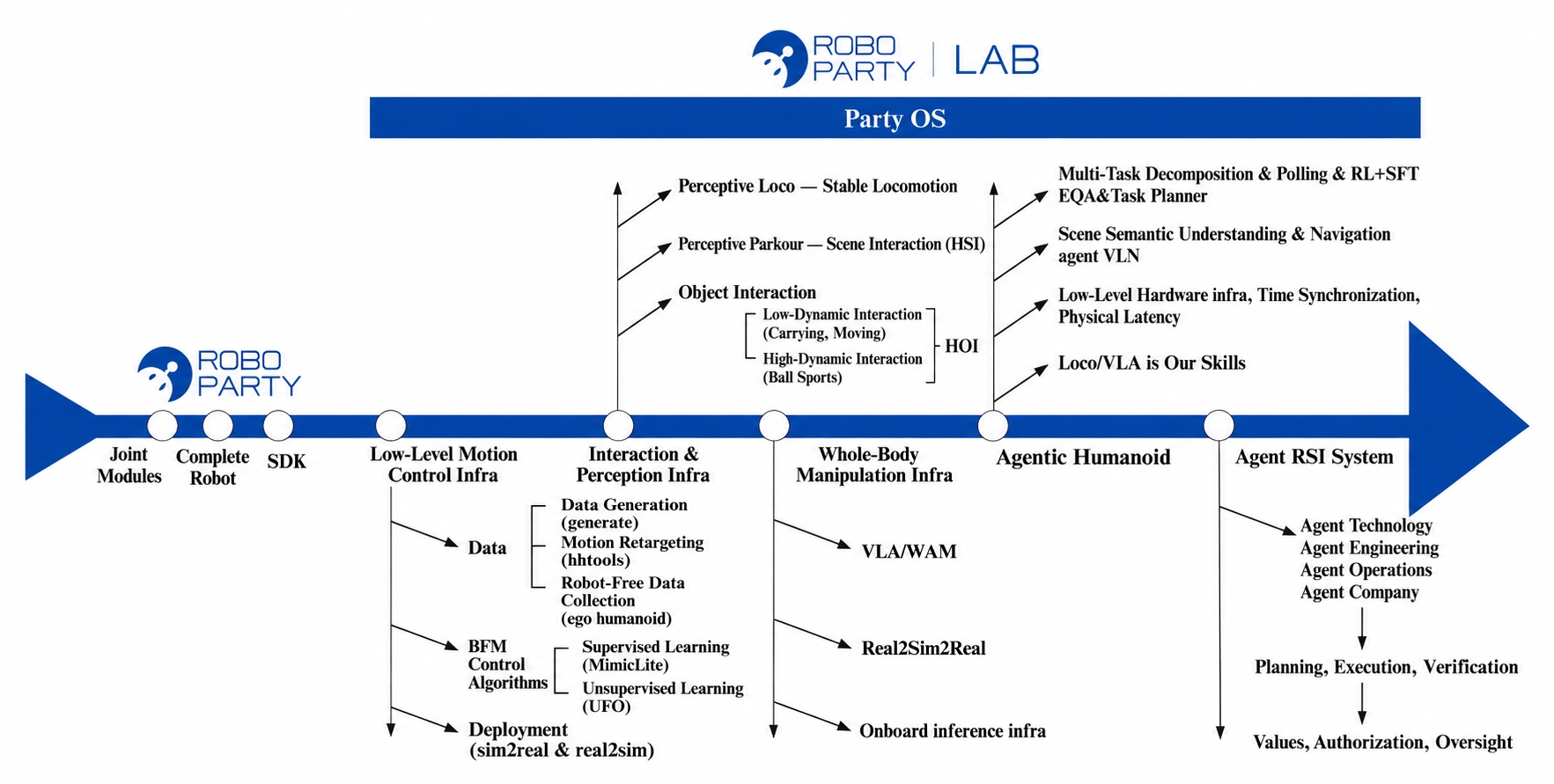
Read the roadmap from left to right. The joint modules, complete robots, and SDK on the far left form RoboParty's hardware foundation. Party OS builds on this foundation across five research directions:
| Direction | Problem to Solve | Areas in the Roadmap |
|---|---|---|
| ① Locomotion Infrastructure | Enable stable, natural whole-body motion and turn new motions into deployable control policies | Data: data generation (generate), motion retargeting (hhtools), and human data collection without a robot (ego humanoid) BFM Control Algorithms: supervised learning (MimicLite) and unsupervised learning (UFO) Deployment: sim2real and real2sim |
| ② Perception and Interaction Infrastructure | Enable robots to perceive their surroundings and sustain motion and interaction in complex real-world environments | Perceptive locomotion (Perceptive Loco) Scene interaction (Perceptive Parkour, HSI) Object interaction (HOI): low-dynamic interaction (carrying and moving objects) and high-dynamic interaction (ball sports) |
| ③ Whole-Body Manipulation Infrastructure | Coordinate the whole body for manipulation and improve generalization across tasks and environments | VLA / WAM Real2Sim2Real Onboard Inference Infrastructure |
| ④ Agentic Humanoid | Enable robots to understand tasks, break them into steps, and combine existing skills to work autonomously through an Agent + Skills architecture | Multi-task decomposition and polling, RL + SFT; EQA and task planning (Task Planner) Semantic scene understanding and navigation (Agent VLN) Low-level hardware infrastructure: time synchronization and physical latency Locomotion and VLA as skills invoked by agents (Loco / VLA is Our Skills) |
| ⑤ Agentic RSI System | Extend agent systems beyond planning, execution, and verification to values, authorization, and oversight | Agent technology, Agent engineering, Agent operations, and Agent companies |
2. Available Work#
The table below summarizes the public projects currently documented in Party OS. Complete Chinese and English guides for INTACT, PredActor, I-BFM, and P-BFM were added on October 20, 2026. Each guide links to project code, papers, and any released data or models.
| Project | Area | What It Does | Public Materials | Validation |
|---|---|---|---|---|
| Human-Humanoid Tools (hhtools) | ① Data · Retargeting | Maps human motion or another robot's motion onto any URDF humanoid robot. Retargeting a single complex motion takes about 30 seconds. Supports batch processing, robot-to-robot transfer, and motion data analysis and visualization | Code, project page, demos | Open-source software tool |
| MimicLite | ① BFM · Supervised Learning | General-purpose humanoid motion tracking: given a reference motion, the trained policy follows it under physical constraints. According to the technical report, a policy can be trained in about 3 hours on 8 RTX 4090 GPUs | Code, technical report, demos | Unitree G1 hardware: low-latency PICO teleoperation and dynamic motions such as cartwheels and spinning kicks; the website also includes an RP1 motion tracking demo |
| UFO | ① BFM · Unsupervised Learning | An unsupervised reinforcement learning framework for control. It first pretrains a reusable whole-body behavior space without task-specific rewards, then invokes it through motion tracking, goal reaching, or rewards. Provides two training routes: FB (reproducing and improving BFM-Zero) and TeCH | Code, technical report, project page, demos | Unitree G1 hardware: teleoperation and disturbance rejection; adaptation to new robots is experimental |
| TeCH | ① BFM · Unsupervised Learning (integrated into UFO) | An unsupervised control method based on temporal-distance representations and contrastive learning, for zero-shot motion tracking and goal reaching | Paper (preview), demos | Simulation and real-robot experiments; see the paper |
| Sim2Real (ROBOTO_ORIGIN) | ① Deployment | The training and deployment pipeline for RoboParty's open-source humanoid ROBOTO_ORIGIN: reinforcement learning environments, Sim2Sim transfer, and a ROS 2-based real-robot deployment framework | Code, documentation | The repository describes reproducible walking and running |
| INTACT (INTACT-JEPA) | ③ Manipulation · World Model | An end-to-end JEPA world model built on LeWM that directly generates action chunks from current and goal images without large-scale candidate search | Code, paper, project page, models, user guide, and demo | PushT, Cube, Reacher, and TwoRoom visual control benchmarks; 95.61% single-task Direct average success |
| PredActor | ① Diffusion Policy | Jointly predicts future whole-body states and actions, sending actions directly to joint controllers with text conditioning and whole-body guidance | Code, paper, models and data, user guide | Runs at 50 Hz on an onboard Jetson Orin NX; the guide covers simulation evaluation, collection, and training |
| I-BFM | ① BFM · Object Interaction | Learns joint representations of robot, object, and contacts; reward-inferred intents support carrying, pushing, and kicking boxes | Code, paper, released model, replay, user guide | MuJoCo interaction tasks and disturbance recovery; repository excludes real-robot deployment software |
| P-BFM | ① BFM · Perceptive Control | Combines intent, depth perception, and heading/velocity commands to adapt one policy to different terrains | Code, paper, interactive tool, user guide | Motion tracking, goal reaching, and terrain evaluation; inference requires training your own weights |