Project Background#
RoboParty ROBOTO ORIGIN, also known in Chinese as the Luobotou Prototype, is a fully open-source biped humanoid robot prototype platform for makers, research, and education. It records RoboParty's phased results in developing a humanoid robot prototype from scratch, and provides a verifiable, learnable, and extensible entry path for users who want to understand, reproduce, and further develop embodied robot systems.
RoboParty is Shanghai RoboParty Technology Co., Ltd., founded on February 21, 2025. The company focuses on frontier humanoid robot technologies and open-source ecosystem development. With "low cost, high performance, and open sharing" as its core philosophy, RoboParty aims to lower the barrier to humanoid robot research, development, and learning through full-stack open source, so more developers, researchers, and education users can truly understand and control robot systems.
In April 2025, RoboParty officially began humanoid robot development and completed its first prototype capable of running and jumping in about four months. As later product development progressed, the team decided to officially open-source this prototype. The goal is both to record the early exploration process and to let the community keep extending the project based on real hardware, real code, and real training and deployment workflows.
Product Positioning#
ROBOTO ORIGIN is designed for users who want to understand embodied robot systems from the ground up. It is suitable for teaching experiments, algorithm validation, motion control research, embodied intelligence exploration, and engineering training. It can also serve as a prototype platform for robot developers who want to carry out secondary development.
- For makers and developers, it provides a reproducible, disassemblable, and modifiable humanoid robot body.
- For research users, it provides a closed-loop experimental foundation from hardware to algorithm deployment.
- For education scenarios, it can support robotics course experiments, innovation practice, competitions, and engineering training.
- For the open-source community, it provides a sustainable starting point for co-creating humanoid robots.
Product Parameters Overview#
Basic Parameters#
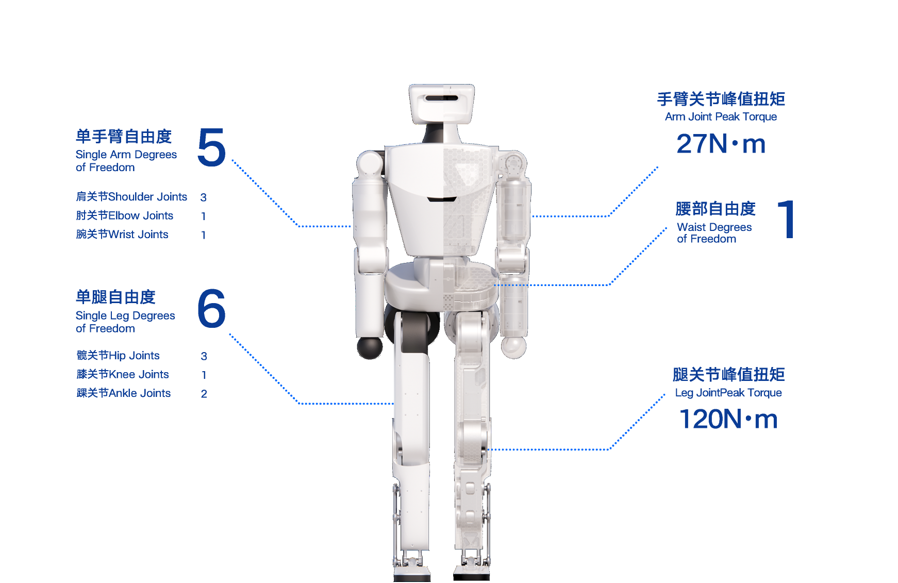
ROBOTO ORIGIN adopts a biped humanoid robot form factor. The full robot is about 1.25 m tall, weighs about 34 kg, and has 23 degrees of freedom. It emphasizes highly dynamic motion capability, maintainable structure, and engineering reproducibility. Users can assemble, train, and deploy the robot on real hardware based on public materials.
| Item | Parameter |
|---|---|
| Height | 1.25 m |
| Degrees of freedom | 23 DOF |
| Weight | 34 kg |
| Thigh length | 250 mm |
| Shank length | 300 mm |
| Total length of one arm | 440 mm |
| Motion performance | Up to about 3 m/s |
| Joint peak torque | 120 N*m |
| Battery | 48 V, 15 Ah |
| Runtime | More than 2 hours |
| Optional perception | Intel D435i depth camera, 3D LiDAR |
Mechanical Structure#
ROBOTO ORIGIN uses industrial-grade CNC-machined parts, combined with designs such as parallel ankles and humanoid offset joints. This allows the robot to keep humanoid proportions while maintaining good structural strength and a solid foundation for motion control. The product parameters indicate that the leg joints can reach a peak torque of 120 Nm, while the arm joints can reach a peak torque of 27 Nm. Together with the 48 V, 15 Ah battery system, this provides the hardware conditions needed for walking, running, and validating highly dynamic bipedal motion.
System Architecture Features#
ROBOTO ORIGIN uses a modular, fully open system design. The knowledge base organizes the content into hardware and electrical systems, embedded software, assembly and calibration, algorithms and simulation, deployment and SDK, industrial design, and other parts. This means it is not a single code repository or a single hardware model, but an open-source engineering system organized around the complete humanoid robot development process.
- Full-stack open source: Covers mechanical structure, electrical design, embedded firmware, training code, simulation models, real-robot deployment, and SDK, reducing technical black boxes as much as possible.
- Hardware-software collaboration: The hardware structure, control deployment, and algorithm training are designed to work together, rather than building the hardware first and adapting software in isolation later.
- Modular maintenance: By separating structure, electrical systems, deployment, training, and other modules, users can read, reproduce, debug, or replace specific parts according to their goals.
- Real-robot friendly: The deployment and SDK documents are written for real robot operation, supporting real-hardware development workflows from drivers, inference, and gamepad control to Python calls.
- Extensible: Based on ROS 2, robot description files, and open interfaces, the system can later connect to perception, navigation, teleoperation, evaluation, or new motion policies.
Our Open-Source Philosophy#
The core value of ROBOTO ORIGIN is not only the release of a humanoid robot prototype, but also the public disclosure of the process of designing, manufacturing, training, and deploying a robot. For beginners, it is a path to understanding embodied robot systems. For developers, it is an engineering foundation that can be disassembled, reproduced, and further modified. For research and education users, it provides a physical platform for low-cost validation of algorithms and closed-loop systems.
This approach to open source lets users do more than "use a robot"; it allows them to understand the robot. Why the mechanical structure is designed this way, how the electrical system is connected, how the firmware supports communication, how the training policy is deployed to the real robot, and how the deployment code drives the whole machine can all be found through the corresponding entries in the knowledge base and sub-repositories.
Open-Source Scope#
The project opens materials around mechanical structure, electrical design, firmware, training code, deployment framework, robot description files, and documentation tutorials. Users can gradually understand the complete system from drawings, BOM, control code, and training workflows to real-robot deployment.
| Scope | Content |
|---|---|
| Mechanical and hardware materials | Structural design, PCB, manufacturing materials, and BOM |
| Firmware and image materials | USB2CAN firmware, content related to building main controller images |
| Training materials | Isaac Lab, RSL-RL, AMP, BeyondMimic, Parkour, Sim2Sim, and other training workflows |
| Deployment materials | ROS 2 deployment framework, hardware drivers, inference, gamepad control, and Python SDK |
| Robot description | URDF, MJCF, models, and simulation description files |
| Knowledge base documentation | Safety, assembly, wiring, calibration, deployment, SDK, and FAQ |